https://en.wikipedia.org/wiki/Millet
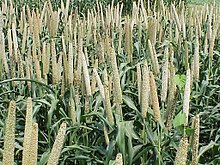


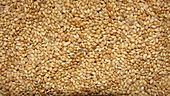
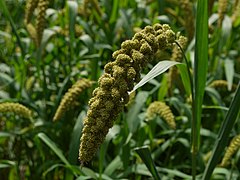
Millets (/ˈmɪlɪts/)[1] are a group of highly variable small-seeded grasses, widely grown around the world as cereal crops or grains for fodder and human food. Millets are important crops in the semiarid tropics of Asia and Africa (especially in India, Mali, Nigeria, and Niger), with 97% of millet production in developing countries.[2] The crop is favored due to its productivity and short growing season under dry, high-temperature conditions.
Millets are indigenous to many parts of the world.[3] The most widely grown millet is pearl millet, which is an important crop in India and parts of Africa.[4] Finger millet, proso millet, and foxtail millet are also important crop species.
Millets have been important food staples in human history, particularly in Asia and Africa. They have been in cultivation in East Asia for the last 10,000 years.[5]
Major millets[edit]
Major millets are the most widely cultivated species.[4]
Eragrostideae tribe :
- Eleusine coracana : Finger millet (also known as ragi, nachani in Marathi, mandua or kezhvaragu in Tamil in India).
Paniceae tribe :
- Panicum miliaceum: Proso millet (syn. : Common millet, broomcorn millet, hog millet or white millet, "chena" or chin in Hindi, "pani-varagu" in Tamil, "baragu" in Kannada).
- Pennisetum glaucum: Pearl millet (also known as sajjalu in Andhra Pradesh, sajje in Kannada and kambu as referred by other South Indian states, "bajri" in Marathi and bajra in Hindi) - the most cultivated millet.
- Setaria italica: Foxtail millet - (also known as korralu in Andhra Pradesh and thinai in Tamil Nadu and kang or rala in Maharashtra, kakum in Hindi).
Andropogoneae tribe :
- Sorghum bicolor: Sorghum - usually not considered being a millet, but sometimes known as Great millet, as well as jonna in Andhra Pradesh, jolla in Kannada, vellai cholam in Tamil Nadu, "jwari" in Marathi and jowar in Hindi.
Minor millets[edit]
Andropogoneae tribe :
- Coix spp.: Job's tears - of minor importance as a crop.[3]
Eragrostideae tribe :
Paniceae tribe :
- Digitaria spp.: White fonio, Black fonio, Raishan, Polish millet - of minor importance as a crop.[3]
- Echinochloa spp.: Japanese barnyard millet, Indian barnyard millet (syn.: Sawa millet) (also known as Kodisama in Andhra Pradesh and "Kuthirai vaali" in Tamil Nadu and Bhagar or Varai in Maharashtra), Burgu millet, Common barnyard grass (or Cockspur grass). Collectively, the members of this genus are called barnyard grasses or barnyard millets. Other common names to identify these seeds include Jhangora, Samo seeds or Morio / Mario / Moraiaya seeds.
- Panicum sumatrense : Little millet (also known as Samalu in Telugu and "Samai" in Tamil Nadu)
- Paspalum scrobiculatum: Kodo millet (also known as Varigalu in Andhra Pradesh and "Varagu" in Tamil Nadu)
- Urochloa ramosa :Browntop millet (also known as Korle in Karnataka)
- Urochloa spp. (also known as Brachiaria): Guinea millet
Thinai (foxtail) millet Varagu (kodo) millet
Foxtail Millet is known to have been the first domesticated millet. Chinese legends attribute the domestication of millet to Shennong, the legendary Emperor of China.[6]
Similarly, millets have been mentioned in some of the oldest extant Yajurveda texts, identifying foxtail millet (priyangava), Barnyard millet (aanava) and black finger millet (shyaamaka), indicating that millet consumption was very common, pre-dating to 4500 BC, during the Indian Bronze Age.[7]
Specialized archaeologists called palaeoethnobotanists, relying on data such as the relative abundance of charred grains found in archaeological sites, hypothesize that the cultivation of millets was of greater prevalence in prehistory than rice,[8]especially in northern China and Korea. Millets also formed important parts of the prehistoric diet in Indian, Chinese Neolithic and Korean Mumun societies. Broomcorn (Panicum miliaceum) and foxtail millet were important crops beginning in the Early Neolithic of China.
For example, some of the earliest evidence of millet cultivation in China was found at Cishan (north). Cishan dates for common millet husk phytoliths and biomolecular components have been identified around 8300–6700 BC in storage pits along with remains of pit-houses, pottery, and stone tools related to millet cultivation.[5] Evidence at Cishan for foxtail millet dates back to around 6500 BC.[5] A 4,000-year-old well-preserved bowl containing well-preserved noodles made from foxtail millet and broomcorn millet was found at the Lajia archaeological site in China.[9]
Palaeoethnobotanists have found evidence of the cultivation of millet in the Korean Peninsula dating to the Middle Jeulmun pottery period (around 3500–2000 BC).[10] Millet continued to be an important element in the intensive, multicropping agriculture of the Mumun pottery period (about 1500–300 BC) in Korea.[11] Millets and their wild ancestors, such as barnyard grass and panic grass, were also cultivated in Japan during the Jōmon period some time after 4000 BC.[12]
Asian varieties of millet made their way from China to the Black Sea region of Europe by 5000 BC.[13] The cultivation of common millet as the earliest dry crop in East Asia has been attributed to its resistance to drought,[5] and this has been suggested to have aided its spread.[13]
Pearl Millet was domesticated in the Sahel region of West Africa, where its wild ancestors are found. Evidence for the cultivation of Pearl Millet in Mali dates back to 2500 BC,[14] and Pearl Millet is found in South Asia by 2300 BC[15]
Finger Millet is originally native to the highlands of East Africa, and was domesticated before the third millennium BC. It's cultivation had spread to South India by 1800 BC.[16]
Research on millets is carried out by the International Crops Research Institute for the Semi-Arid Tropics and ICAR-Indian Institute of Millets Research [17] in Telangana, India, and by the USDA-ARS at Tifton, Georgia, United States.